


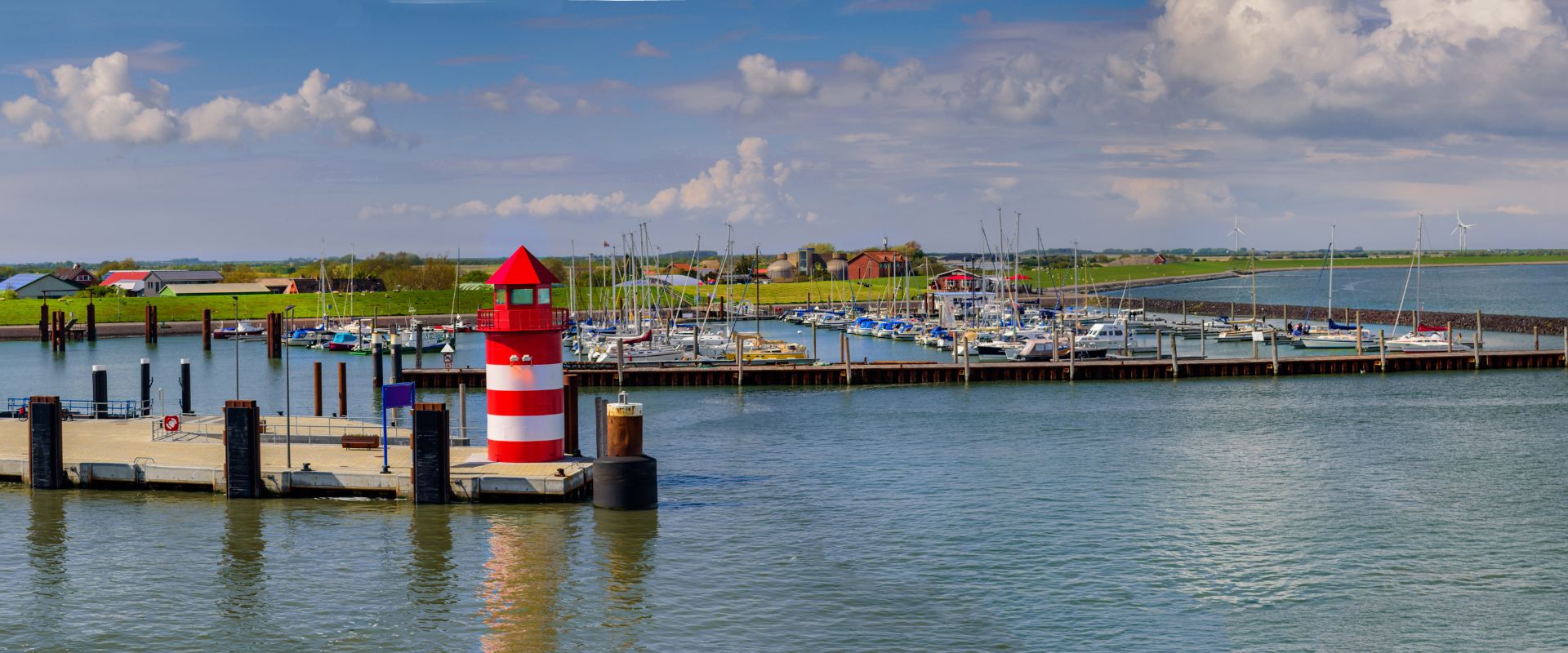
Föhr, a beloved destination among German holidaymakers, is a Wadden Sea island belonging to the North Frisian Islands along the coast of Schleswig-Holstein. The island attracts thousands of visitors each year who come to enjoy peace and the charming countryside with its thatched-roof houses. Ferries from Dagebüll and Harlesiel make regular crossings. The coastline features long sandy beaches as well as dikes that are perfect for a cycling trip. At low tide, you can walk to the neighbouring island of Amrum straight from your holiday home on Föhr.
This town is the island’s most prominent settlement and invites visitors for a pleasant stroll along the promenade. A lovely strip of grass with trees separating the beach from the promenade provides a peaceful setting. Parallel to this tidy and atmospheric promenade lies a shopping street filled with bakeries, cafés, restaurants and boutiques.
From your holiday home on Föhr, discover more about the island’s history at the Dr. Carl Häberlin Friesenmuseum and admire a large collection of amber and fossils. Archaeological finds exhibited here indicate that the island’s early inhabitants not only relied on grain cultivation but also on hunting and fishing. Another source of income was salt extraction from the salt marshes. In the late Middle Ages, the population experienced the most prosperity thanks to whaling — the blubber and oil were valuable fuel for lighting. The whale jaws displayed at the entrance refer to the use of whalebone as a building material in those times.
Föhr is extremely flat, yet there is one area that stands out: the Goting coastline. While the dunes here are not high, their steep form resembles a low cliff. Remarkable, too, are the boulders on the beach, which date back to the Ice Age. This is a great place to spend time with children thanks to the very gently sloping beach. In Nieblum, a village with charming farmhouses, you’ll find a café, a dog-friendly beach, a boardwalk through the dunes and opportunities for kitesurfing. A walk along the fine sandy beach easily takes over an hour. Public toilets are available if needed.
The east coast of Föhr offers the possibility of walking across the mudflats to Amrum at low tide — a fun activity that also takes you to a completely different type of island. Vast dunes, heathland and forest dominate the landscape, and the Kniepsand is one of the largest sand formations in Europe. Walking across this white sand plain is both beautiful and unique thanks to the seamless blend of beach and dunes. A winding boardwalk then crosses the immense dune landscape. You will also find a swamp forest and a reconstructed prehistoric farmstead.
Are you considering a mudflat crossing to Amrum with a ferry trip back to Föhr? Use bus line 1 to reach Utersum, where the distance to Amrum is the shortest. A ferry offers the option to return to Föhr. For this, you’ll walk 10 kilometres to the southern town of Wittdün auf Amrum, the departure point for all ferry services to the mainland and other North Frisian islands. You can also take the bus in Norddorf auf Amrum if you find the full route, including the mudflat walk from Föhr, too demanding.
Föhr and the Wadden Sea area form a unique habitat. For an educational introduction to this tidal landscape, visit the Nationalpark Haus Föhr in Wyk auf Föhr. Three different rooms introduce you to the animals that thrive here, from migratory birds and seals to scorpions and fish.
In the Museum Kunst der Westküste, located in Alkersum, you can admire paintings and photography related to the North Sea. Beautiful works capturing the coastal atmosphere and play of light hang proudly on the walls. The artworks are displayed in rooms representing different countries, including Denmark, Germany and the Netherlands. Paintings of Norwegian fjords are also part of the collection. The museum is one of the island’s highlights and can be combined with coffee and a treat in the inner courtyard. Looking for a special souvenir? The museum shop offers shelves full of products and memorabilia.
There may not be many activities on Föhr, but if you’re looking for a fun experience, you won’t be disappointed. In Wyk auf Föhr, there is a kart track where you can race along a winding circuit at speeds of up to 50 kilometres per hour. Children can also participate using karts with adjusted speeds. Anyone from the age of nine can enjoy a safe and exciting experience here, regardless of skill level.
An authentic hamlet well worth visiting from a holiday home on Föhr is Oldsum. White, thatched-roof houses and a windmill create a picturesque scene, and despite its small size, you’ll be warmly welcomed at Café in Apfelgarten, set in a garden with apple trees. Whether you’re looking for a good lunch break or a stop for cake and whipped cream, this is the right place. Cycle onwards to Utersum for a walk along the dike promenade or the beach. A sunset, a German meal, a beer or glass of wine and Föhr cheese make this village — with its four café-restaurants — perfect for a summer evening.
For beaches, tranquillity and cultural-historical museums, a holiday home on Föhr is an excellent choice. The island’s size, comparable to Ameland, makes it easy to navigate yet large enough for enjoyable cycling trips. Authentic villages with thatched-roof houses lie along the route, and you cycle alternately along dikes and beaches. A special highlight is a mudflat walk to the neighbouring island of Amrum, where you can enjoy a stunning north-to-south hike through the dune landscape.
